


An online casino may offer thousands of games, yet players still need to find the titles that interest them. As game portfolios expand, how content is organised and presented becomes as important as the variety of games available.
For casino operators, managing the lobby means making decisions about game categories, featured titles, navigation and the visibility of different providers. But how can operators determine whether those decisions are effective? And when does it make sense to introduce AI-powered personalisation?
In this article, we explore how operators can organise their casino lobby, evaluate game placement and measure results, drawing on practical insights shared by Elma Viljoen, Business Account Manager at BGaming.
In this article
-
-
- What Is Casino Lobby Optimisation?
- How Should Operators Organise Their Casino Game Lobby?
- Does Game Placement Affect Casino Performance?
- How Can Operators Measure and Test Lobby Performance?
- From Static Lobbies to AI-Powered Personalisation
- What Should Operators Prioritise Before Redesigning Their Casino Lobby?
- Final Considerations
-
What Is Casino Lobby Optimisation?
Casino lobby optimization is the process of organising, presenting and continuously evaluating the games available within an online casino.
It goes beyond visual design. An effective lobby should make relevant content easy to discover, support intuitive navigation and give operators control over how their portfolios are presented.
Consider two casinos offering the same catalogue. One displays hundreds of titles in broad categories, while the other introduces dedicated sections for crash games, new releases and popular titles, supported by search and filtering options.
Although the content is identical, the player experience and opportunities for game discovery can be very different.
The objective is not simply to promote more games. It is to help players navigate the catalogue while giving operators an efficient way to manage and update it.
How Should Operators Organise Their Casino Game Lobby?
There is no universal casino lobby layout that works equally well for every audience.
Game categorisation is a useful starting point. Slots, live casino, crash games and other instant games may deserve distinct sections, depending on player demand and the size of the portfolio. Categories should simplify discovery rather than introduce unnecessary complexity.
Game visibility requires a similar balance. Popular titles can provide familiar starting points, while dedicated sections for new releases or less-established games allow players to explore beyond the most recognisable products.
Mobile experience also matters. On smaller screens, fewer game cards are visible at once. Category order, loading performance and navigation therefore deserve particular attention, especially in markets where entry-level smartphones and variable network conditions are common.
Categorization plays an important role in helping players discover new games. Simply adding titles to the lobby is not enough. Players need clear categories to find games that match their interests. For example, fans of classic fruit slots should be able to discover new titles in the same style. At BGaming, we believe that a well-organized lobby makes it easier for players to explore our games, find their favourites, and discover something new. Without proper categorization, even great games can get lost among other releases.
— Elma Viljoen, Business Account Manager, BGaming
Adding games and making them discoverable are two different tasks, and both should be considered when updating the lobby.
Does Game Placement Affect Casino Performance?
A game’s position within the lobby can influence how easily players encounter it. A title displayed near the top of a page has a different opportunity for exposure than one positioned several screens below.
However, visibility and player preference are not the same thing.
A popular game may occupy a prominent position because it already attracts substantial interest. In that situation, higher game launches could reflect existing demand rather than the placement itself.
Other elements can influence the results, including thumbnails, promotional campaigns, category placement and device type.
For this reason, operators should distinguish between how often a game is displayed, how often players select it and what happens after it launches.
“At BGaming, we know that lobby positioning, category placement and promotions all influence a game’s launch. A high position can attract more players, but visibility alone doesn’t tell the full story. We look at performance alongside the support a game receives and, most importantly, whether players keep coming back after the promotion ends. Repeat engagement gives us a better idea of the game’s stickiness.”
— Elma Viljoen, Business Account Manager, BGaming
The effect of placement should ultimately be assessed using the operator’s own data, rather than assumed from visibility alone.
How Can Operators Measure and Test Lobby Performance?
Rather than relying exclusively on intuition, operators can evaluate their lobby decisions through behavioural metrics and controlled experiments.
Several indicators can help:
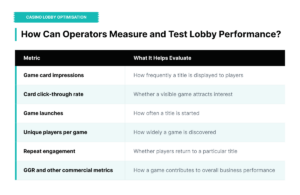
Not every operator has access to all these measurements. The first step is understanding what the platform actually tracks and whether the data is reliable.
One practical approach is A/B testing. An operator could show the same crash game in a prominent position to one randomly assigned group and in a lower position to another, while keeping other relevant variables consistent.
The results could be assessed using game launches per eligible lobby session, supported by exposure and click data. Revenue and engagement should also be interpreted in context rather than used as isolated indicators.
The goal is not to prove that the first row always performs better, but to determine whether a placement decision makes a measurable difference for a specific audience.
“After a game launches, we look at several signals to understand how it performs. These include the number of players it attracts, D7 retention, session length, spin count and bets per player. We also track GGR and LTV, taking into account the game’s RTP and how much data we have collected so far.
For example, following the end of the launch promotion for one of BGaming’s recent releases, its daily player count declined, while the number of bets per player and the average bet volume continued to grow. Looking only at audience size would have missed this shift in player activity. That’s why we look at several metrics together rather than judging a game by one number alone.”
— Elma Viljoen, Business Account Manager, BGaming
From Static Lobbies to AI-Powered Personalisation
Casino lobbies can be managed through different levels of automation.
Static lobbies present broadly the same game selection to every player. They offer consistency and direct editorial control, but do not adapt to individual preferences.
Rule-based lobbies adjust categories or featured content according to predefined criteria, such as market, language, device type or player segment.
AI-powered recommendation systems can go further by using available behavioural signals and game characteristics to suggest content that may be relevant to individual players.
For example, a recommendation engine might consider previously played game categories or navigation behaviour when selecting titles for a personalised section.
Importantly, AI-powered recommendations are not the same as AI-generated lobby design. The former determine which games to display or prioritise; the latter concerns the structure or creation of the interface itself.
A practical example comes from Boost Casino, an Entain brand that introduced personalised game recommendations through ZingBrain AI. According to the companies, an A/B experiment recorded improvements in selected engagement and commercial metrics.
While these findings are worth considering, vendor-reported results should not be treated as a guarantee of performance for other operators.
AI personalisation also introduces challenges involving data quality, integration, limited player history, privacy and responsible gambling safeguards.
Before adopting these systems, operators should establish whether the expected improvement justifies the technical and operational complexity.
What Should Operators Prioritise Before Redesigning Their Casino Lobby?
Before introducing new layouts or personalisation technologies, operators should identify the specific problem they want to solve.
If players struggle to navigate a large catalogue, clearer categories, search tools or filters may be more useful than an advanced recommendation engine.
If new games receive limited exposure, operators should investigate their placement and presentation before assuming the content itself is underperforming.
If reliable behavioural data is already available, segmentation and controlled testing can provide a foundation for more advanced personalisation.
Operational flexibility matters too. Teams should understand whether they can independently reorder games, create categories and adjust featured sections, or whether each change requires additional technical work.
The ideal approach depends on the casino’s audience, existing capabilities and business priorities. AI may support better decisions, but it cannot replace a clear content strategy or reliable performance measurement.
Final Considerations
Casino lobby optimisation is not simply about placing popular games at the top of the page. It involves understanding how players discover content, testing how presentation influences their choices and making informed decisions about the technologies used to manage the experience.
From curated categories to AI-powered recommendations, the most effective approach is the one that fits the operator’s audience, portfolio and operational capabilities.
A well-managed lobby should remain easy to navigate, flexible enough to evolve and supported by evidence rather than assumptions.

