


Nigeria is one of Africa’s largest and most competitive online betting markets. Sports betting, online casino and lottery products can be offered legally, but operators should not assume that a single federal licence provides access to the entire country.
In 2024, the Supreme Court confirmed that gaming and lottery regulation falls primarily within state jurisdiction. The licences and authorisations an operator needs therefore depend on the states in which it serves players, the products it offers and whether those states participate in the country’s reciprocity framework. Recent Lagos High Court rulings and the September 2026 enforcement action involving Stake.com show how state-level requirements can also apply to online operators whose offices or servers are located elsewhere.
These changes affect more than the licence application. Operators need platforms capable of controlling access by jurisdiction, applying the relevant compliance rules and producing reliable operational and financial records. This guide explains how the Nigeria online gambling licence system works in 2026, how to identify the licences and regulatory approvals required in each target jurisdiction and which technical requirements operators should prepare for.
Table of contents
-
-
- Is Online Gambling Legal in Nigeria?
- How Nigeria’s Gaming Licensing System Works in 2026
- Who Regulates Online Gambling in Nigeria?
- How to Identify the Correct Nigeria Gaming Licence
- What Recent Court Rulings Changed for Operators
- Nigeria Gaming Licence Requirements
- How to Apply for a Nigeria Gambling Licence
- Preparing Your Platform for the Nigerian Market
- Ongoing Compliance After Launch
- Nigeria Market-Entry Checklist for iGaming Operators
- FAQ
- Is Online Gambling Legal in Nigeria?
-
Is Online Gambling Legal in Nigeria?
Yes. Online gambling is legal in Nigeria when the operator holds the appropriate authorisation and complies with the rules that apply where its players are located. The market supports regulated online sports betting, online casino, public online lottery and promotional competitions, although the required authorisations and technical conditions can differ by product.
The more useful question for an operator is therefore not simply whether online gambling is legal in Nigeria. It is where the product will be available, which regulator has authority in that location and whether the proposed activity is covered by a multi-state licensing framework.
How Nigeria’s Gaming Licensing System Works in 2026
Nigeria does not currently operate as one uniform gaming jurisdiction. Following the Supreme Court ruling, gaming and lottery regulation is primarily state-led. Each state may license and supervise gaming activity within its territory, including services delivered through websites, apps and other remote channels.
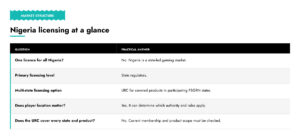
To make multi-state licensing more workable, participating regulators created the Federation of State Gaming Regulators of Nigeria and a Subnational Reciprocity Licensing Framework. Its Universal Reciprocity Certificate, commonly referred to as the URC, provides a coordinated licensing mechanism for specified products across participating states.
The URC is not a new federal licence and it does not automatically cover all 36 states. Operators must still confirm whether each target state is a current FSGRN member, whether their product falls within the framework and whether the state imposes additional registration, levy, reporting or technical requirements.
Nigeria licensing at a glance
Who Regulates Online Gambling in Nigeria?
The relevant regulator depends on the location being served. State gaming authorities are responsible for licensing and enforcement within their own jurisdictions. In Lagos, for example, this role is carried out by the Lagos State Lotteries and Gaming Authority.
FSGRN coordinates participating state regulators and administers the reciprocity framework. It does not turn Nigeria into a single national licensing territory; it provides a shared licensing mechanism only within the scope accepted by its members.
Federal competence is now generally understood to remain relevant to the Federal Capital Territory. Operators should assess the licensing requirements for the FCT separately rather than assuming that a state licence or URC applies automatically.
Membership of the reciprocity framework can evolve. Early analysis of the framework referred to 22 participating states, while FSGRN and LSLGA’s September 2026 enforcement communication referred to Lagos and 24 other members. This is why a current regulator check is more reliable than a fixed state list copied into a market-entry plan.
How to Identify the Correct Nigeria Gaming Licence
A licensing assessment should begin with the operator’s actual distribution model. The same website may require different treatment depending on the product offered and the Nigerian states from which players can register, deposit and place bets.
FSGRN member states
For a product covered by the reciprocity framework, the URC may authorise operations across participating jurisdictions. The operator should verify current membership, the categories included in the certificate and any local conditions that remain payable or reportable at state level.
Non-member states
Where a target state does not participate in the framework, the operator should assess the licence, permit or registration required by that state. Access from players in the jurisdiction may be enough to trigger local obligations even if the company, management team or servers are based elsewhere.
Federal Capital Territory
The FCT requires a separate review of the applicable federal requirements. Operators should not assume that an authorisation designed for participating states extends to Abuja, or that an older federal licence still provides nationwide coverage.
The practical sequence is simple: map the product, map the player locations, identify the licence or authorisation required in each location, then configure the platform to enforce the resulting permissions and obligations.
What Recent Court Rulings Changed for Operators
The Supreme Court and state jurisdiction
On Nov 22, 2024, the Supreme Court delivered its judgment in Attorney-General of Lagos State & Ors v Attorney-General of the Federation & Ors, suit SC.1/2008. The Court held that lotteries and gaming are residual matters within state legislative competence because they do not appear on the Constitution’s Exclusive or Concurrent Legislative Lists.
The decision invalidated the National Lottery Act 2005 as the basis for nationwide federal control. Its operational effect is that an NLRC licence should not be assumed to cover every Nigerian state. The refusal of presidential assent to the proposed Central Gaming Bill in 2026 further confirmed the state-led direction of the market.
Recent Lagos High Court rulings
LSLGA has also published notices on Lagos High Court judgments involving Zegaming Nigeria, Africa Betting Company Nigeria and Mozzartbet Services. According to the regulator, the decisions support its authority over operators serving Lagos residents through physical, online or remote channels.
The enforcement logic follows the player. Offices, servers or management located outside Lagos do not by themselves remove local obligations when a platform accepts wagers from people in the state. For offshore operators, that makes the question “can an online betting operator accept bets from Lagos residents without a local authorisation?” commercially and technically significant.
What the Stake.com case signals
In September 2026, LSLGA and FSGRN declared Stake.com’s operations unlawful in Lagos and 24 other member states. According to the regulators, the operator had received at least ten notices over two years and had not registered its operations, declared local earnings or remitted the required gaming taxes and levies.
This was an enforcement announcement, not a new court judgment. Its relevance lies in the coordinated response and the number of connected parties exposed to action. The authorities said enforcement could extend to directors, payment companies, financial institutions, advertising platforms, influencers and other facilitators of unlicensed activity.
For operators, the case turns a legal principle into an operating question: can the platform identify where players are located, restrict unauthorised access, separate reporting by jurisdiction and produce reliable records of transactions, revenue and partners?
Nigeria Gaming Licence Requirements
Exact requirements vary by state, product and type of authorisation. Operators should confirm the current criteria before filing rather than treating any published fee or document list as permanent. The online sports betting requirements currently published by FSGRN nevertheless show the level of preparation expected.
- a Nigerian incorporated company, ownership and director information, tax clearances and a detailed business plan;
- minimum share capital of ₦100 million and a ₦100 million bank guarantee or acceptable surety bond;
- an application fee of ₦5 million under the published online sports betting requirements;
- technical documentation covering hosting, servers, databases, security architecture and redundancy;
- due diligence on bookmakers, B2B suppliers and technology partners, supported by executed service-level agreements;
- independent platform testing by GLI or BMM against the applicable standard;
- SCUML certification and appropriate AML/CFT controls.
These figures were current in the source material reviewed for this guide and may change. Online casino content added to a sportsbook may also require further technical approval. Operators should validate the applicable requirements directly with the relevant regulators before committing budgets or timelines.
How to Apply for a Nigeria Gambling Licence
The application process should be planned at a high level because forms, fees and procedural requirements can change. A typical operator journey includes:
- define the product scope, target states and player-access model;
- identify whether the URC, a state-specific licence or an FCT authorisation applies;
- prepare corporate, ownership, financial, tax and compliance documentation;
- submit technical architecture, supplier information and independent certifications where required;
- complete regulator due diligence, address queries and confirm any pre-launch inspections or integrations.
The final application process should always be checked with the relevant authority. Legal and tax advisers can confirm the formal requirements; the operator’s platform and technical teams must ensure that the operating model described in the application can be delivered after approval.
Preparing Your Platform for the Nigerian Market
Once the required licences and authorisations have been identified, they must be translated into platform rules. Operators need to determine where players are accessing the service, control which products are available in each jurisdiction, separate reporting and regulatory obligations, and maintain records that can be produced during an audit. In Nigeria, licensing geography directly affects platform configuration.
A Nigeria gaming licence increasingly reaches into the technology beneath the brand. Regulators may require visibility into hosting, platform architecture, technical suppliers, payment flows, player records and the controls used to supervise activity after launch. Lagos’s 2026 technical transition programme also points towards deeper assessment of operators, B2B platforms, payment providers, source code, RNGs and online systems.
In practice, a multi-state operation may need player-location controls, product access by jurisdiction, local KYC and AML workflows, responsible gambling tools, state-level reporting, tax and levy calculations, transaction logs, audit trails and reliable payment reconciliation.
Those controls work best when they share the same player, payment and reporting data. Fragmented systems make it harder to explain which licence covered a transaction, which rules applied to a player and what evidence can be produced during a regulatory review.
Ongoing Compliance After Launch
State licensing operates alongside national obligations. Customer verification, transaction monitoring and SCUML requirements form part of the AML/CFT environment. Player and account data must also be governed under the Nigeria Data Protection Act 2023 and the oversight of the Nigeria Data Protection Commission.
The Nigeria Tax Act 2025, effective from 2026, includes provisions for lottery and gaming income. Operators should align corporate tax treatment, state levies, revenue reporting and the treatment of prizes and commissions with their legal structure and target jurisdictions.
Because membership, technical standards and local requirements may change, compliance should be maintained as an operating process. The platform needs a clear record of licences, products, jurisdictions, suppliers and rule changes rather than a one-off launch file.
Nigeria Market-Entry Checklist for iGaming Operators
- Define the states, products and player segments the operation will serve.
- Confirm whether each target state and vertical falls within the current FSGRN framework.
- Check state-specific licensing, registration, levies, reporting and responsible gambling rules.
- Review the FCT separately where it forms part of the plan.
- Map technology providers, payment partners, hosting and data flows.
- Validate laboratory certification, AML registration, platform documentation and audit readiness.
- Confirm current legal, regulatory and tax requirements before launch.
Operators should also assess the competitive dynamics of the Nigerian betting market. Licensing creates access; product quality, payments, uptime and retention determine whether the operation can compete once it is live.
Planning to Enter the Nigerian iGaming Market?
Entering Nigeria requires a licensing strategy built around the states and products an operator intends to serve, supported by technology that can apply those decisions in daily operations.
PlaylogiQ works with operators across African markets to connect player management, payments, reporting and control tools around real local conditions. If Nigeria is part of your expansion roadmap, an initial conversation can help clarify the operating model, integrations and platform requirements that should sit behind the licence.
Talk to our team about your project.
FAQ
Is online gambling legal in Nigeria?
Yes, regulated online gambling products can be offered with the appropriate authorisation. Licensing is primarily state-led, so the operator must assess where its players are located.
Does an operator need a licence in every Nigerian state?
Not always. The URC can authorise covered products across participating FSGRN states. Non-member states, additional local conditions and the FCT still require separate checks.
Does an FSGRN licence cover all Nigeria?
No. The reciprocity framework applies to participating states and specified products. Membership and local requirements should be confirmed before launch.
Is an NLRC licence valid nationwide?
Nationwide coverage should not be assumed following the Supreme Court ruling. State authorisations and the separate position of the Federal Capital Territory require review.
Can an offshore operator accept bets from Lagos residents?
LSLGA’s published position is that serving Lagos residents can trigger local licensing, registration and tax obligations even when an operator’s offices or servers are outside the state.
What technical requirements apply to online betting in Nigeria?
Published requirements include platform and security architecture, supplier due diligence, SLAs, independent gaming-lab certification, AML registration and auditable operational records.
Sources
- Supreme Court ruling analysis – Wole Olanipekun & Co
- FSGRN Subnational Reciprocity Licensing Framework – Aluko & Oyebode
- FSGRN online sports betting licence requirements
- LSLGA High Court judgments public notice
- LSLGA technical transition and homologation notice
- Nigeria Data Protection Act 2023
- Nigeria Tax Act 2025
- Stake enforcement report – iGaming AFRIKA