



Sports betting in Africa has moved from an access race to a selection problem. A market is investable when licensing is realistically available, taxation leaves a margin, payments settle reliably, and player value covers the cost of reaching that player. Population size, mobile penetration, and headline growth describe potential demand. They do not, on their own, describe an opportunity.
A few years ago, moving early and executing effectively was often enough to establish a position in less crowded markets. That window has narrowed. Operators now face more structured licensing processes, higher compliance expectations, stronger competition and operating conditions that differ sharply between jurisdictions.
This does not mean the opportunity has disappeared. It means the basis for the decision has changed.
This three-part guide examines sportsbook investment in Africa from the perspective of operators, investors and gaming groups. It combines public regulatory sources with first-hand operating experience from PlaylogiQ, which has supported market entry and platform operations across seven African jurisdictions.
This first article covers where genuine market opportunities still exist and how to evaluate them. The second examines how much it costs to start a sportsbook in Africa, including technology, licensing, operations and working capital. The third looks at sportsbook revenue, profitability and break-even.
We begin with the decision that precedes all others: not how large a market appears, but whether it is accessible, operationally viable and economically sustainable for a particular operator.
In this article
-
-
- The state of sports betting in Africa in 2027
- Is it still worth entering an African sportsbook market?
- There is no single African sports betting market
- What makes an African sportsbook market investable?
- African sportsbook markets to watch in 2027
- What do African market reports not tell sportsbook operators?
- Can regulatory risk be mitigated through execution?
- How to choose the right African market for your sportsbook
- How do you decide which African market to enter?
- FAQ
- The state of sports betting in Africa in 2027
-
The State of Sports Betting in Africa in 2027
In several African betting markets, the first wave of sportsbook expansion rewarded speed. Operators that secured access, adapted their product and built local distribution early could establish a position before competition intensified.
That approach is no longer sufficient. Licensing is becoming more structured, compliance requirements more demanding and established competitors harder to displace.
From PlaylogiQ’s field.“In the space of a few years the window narrowed: more structured authorisation procedures, local technical certification requirements, reporting obligations towards the regulator, growing attention to anti-money laundering and player protection. The licence has gone from being a formality to being a selective filter.”
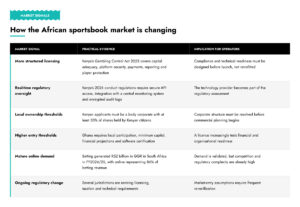
Kenya illustrates the direction of travel most clearly. The Gambling Control Act 2025 replaced the previous framework. It established the Gambling Regulatory Authority, introducing requirements covering online platform authorisation, data security, player verification, payment protection, responsible gambling and capital adequacy.
In 2026, the Authority published five subsidiary regulations and opened the country’s first licensing cycle under the new Act. Among the requirements: real-time regulatory access through a secure API, integration with a central monitoring system and national gambling register, geolocation technology, encrypted audit logs and segregation of player funds from operational accounts.
For an incoming operator, this is not a compliance appendix. It is a platform specification.
Ghana points the same way. Online sports betting applicants must satisfy ownership and capital conditions, provide financial projections, disclose their technology providers and present evidence of software certification.
South Africa demonstrates what a mature African betting market becomes. According to the National Gambling Board, betting accounted for approximately 70% of national gambling GGR in FY2024/25, at R52 billion, with online betting representing 86% of betting revenue. These figures confirm substantial demand – and describe an established, competitive market rather than an uncontested opportunity.
The opportunity has therefore not disappeared. It has shifted from early access to selective, compliance-led investment.
Is It Still Worth Entering an African Sportsbook Market?
The short answer is yes – but not in every jurisdiction, and not for every operator.
A sportsbook market may show strong demand and still represent a poor investment. Licensing may be unavailable or conditional on local participation. Taxation may absorb too much of the gaming margin. Payment methods may exist without providing dependable withdrawals or efficient reconciliation. Customer acquisition may cost more than the value generated by the players it delivers.
Conversely, a smaller market may provide a more sustainable opportunity when competition is less consolidated, payments are reliable, regulatory access is clear and operating costs remain proportionate to player value.
This is because market growth and investability measure different things.
Market growth indicates potential demand. Investability indicates whether an operator can reach, monetise and serve that demand sustainably.
The decision also depends on the operator. A multinational gaming group, a locally established betting company and a new investor relying on a white label platform do not evaluate the same opportunity in the same way. They have different capital reserves, capabilities, regulatory experience and tolerance for operational risk.
An African sportsbook market may be worth entering when four conditions align:
-
-
- The regulatory route is accessible and sufficiently stable.
- The economics remain viable after taxation and operating costs.
- Payments, withdrawals and customer support can function reliably.
- The operator possesses – or can acquire – the local capabilities needed to execute.
-
The fourth condition is frequently underestimated. A market is not investable in the abstract; it is investable for a specific organisation.
Restricted access deserves a separate note. Where the number of authorised operators is capped, that constraint is often read as a barrier when it is closer to a moat.
From PlaylogiQ’s field. “In some jurisdictions the number of authorised operators is very limited. A high barrier is not an obstacle – it is an asset, provided you are on the right side of it.”
There Is No Single African Sports Betting Market
For sportsbook investors, Africa is not one market but a collection of distinct jurisdictions. The most common error among international operators is treating the continent as a single market and transferring a model validated elsewhere. It is not an error of nuance. It is an error of category.
Regulation, taxation, payments, player behaviour and market access change substantially between countries. In some cases, country-level analysis is not granular enough: operators may need to examine individual states or provinces.
The institutional divide that shapes market access
The sharpest structural difference runs between anglophone and francophone systems.
In anglophone jurisdictions, the reference authority is typically a licensing and control body that authorises the private operator directly. In francophone jurisdictions, the perimeter more often originates from a historic national lottery monopoly, which may admit a defined number of private participants within its own framework.
The counterparty changes. The logic of authorisation changes. The documentation changes. The timelines change.
This distinction is a useful starting frame, not a classification. Not every anglophone market follows the same licensing model, and not every francophone market is organised around the same form of state participation. It tells an operator which questions to ask first – it does not answer them.
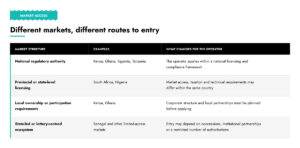
Nigeria illustrates why continental assumptions fail quickly. Following the Supreme Court’s reaffirmation that gaming regulation falls within the residual competence of the states, operators need to assess requirements at state level. Lagos, Rivers, Ogun and Plateau each operate their own regulatory bodies. A large national population therefore does not translate into one national market-access decision.
Senegal presents a different model. Its gaming ecosystem has historically developed around LONASE, the national lottery, which operates both retail and online products. Private participation must be evaluated within a state-led structure rather than through the assumptions applied to an open licensing market.
Where entry projects actually slow down
These differences affect more than documentation. They determine who holds the licence, whether a local partner is required, how payments are integrated, where data can be processed, what reports must be submitted and how responsibilities are divided.
There is a practical consequence that market analysis rarely captures. Moving from one market to another, the heaviest work is not on the platform core.
From PlaylogiQ’s field. “The greatest effort is not on the core of the platform: it is on the integration layers. Payments, identity verification, regulatory reporting, product localisation. That is where time and budget are consumed, and that is where launch plans break down.”
What Makes an African Sportsbook Market Investable?
Population and betting participation are useful starting indicators, but they do not constitute an investment case. Operators need a framework that connects demand to accessibility and economic sustainability.
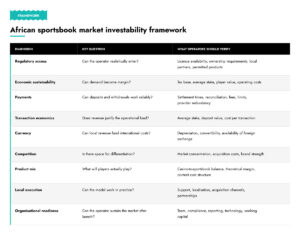
Six of these dimensions are consistently under-assessed by conventional market analysis.
Payments are infrastructure, not a feature
A list of available payment methods says little about whether a payment ecosystem is operationally mature.
In the markets PlaylogiQ operates in, mobile money is not an alternative to cards – it is the primary financial channel. This is not resolved by adding a method to a list. It redesigns the deposit flow, the withdrawal mechanism, the point at which identity verification sits, and the entire reconciliation process.
From PlaylogiQ’s field. “Payment maturity is not measured by the presence of methods, but by actual settlement times and the quality of reconciliation. Those are two figures that do not appear in market reports.”
Operators should examine actual settlement times, withdrawal reliability, transaction limits, failure rates, fixed fees, and reconciliation quality. Provider redundancy matters too: depending entirely on one payment partner turns a temporary service problem into a complete commercial interruption.
There is a sequencing error that follows from underestimating this. A marketing campaign produces registrations and deposits within days. If the withdrawal flow, KYC, or support are not ready, that growth converts entirely into cost and reputational damage.
From PlaylogiQ’s field. “In our experience, the punctuality of the first withdrawal is the single event that decides whether a player stays.”
Why transaction count matters as much as turnover
Large populations may generate substantial transaction volumes without producing proportionate revenue.
Where average stakes are low in hard-currency terms, the result is a high-density operation with minimal unit value. Infrastructure, payment processing, monitoring and reconciliation scale with the number of transactions, not their monetary value. Every bet is a write to the system. Every deposit is a call to a payment API. Every movement is a reconciliation line to manage and retain.
One million bets worth €0.20 and 100,000 bets worth €2 produce the same turnover and the same gross margin. The first produces ten times the processing events, ten times the reconciliation work and a materially higher infrastructure cost.
The largest market can therefore be the one with the highest cost per unit of revenue generated.
Market size should consequently be evaluated together with:
-
-
- average stake in hard currency;
- average deposit;
- betting frequency;
- payment fee structure, with specific attention to any fixed component per transaction;
- player value in a common settlement currency;
- infrastructure and support cost per transaction.
-
Population size predicts the number of transactions. It does not predict revenue. Read separately, the two figures are both misleading.
Can local revenue pay international suppliers?
This is the constraint most consistently absent from market analysis, and in some jurisdictions it is the hardest one.
An operator in these markets generates revenue in local currency while holding a cost base denominated largely in euros or dollars: platform licence fees, casino content, cloud infrastructure, sports data feeds, identity verification tools. Depreciation of the local currency erodes margin in the interval between earning the revenue and settling with the supplier. This is not an exchange risk to hedge occasionally. It is a structural compression of margin that belongs in the financial plan from the outset.
More severe than the rate is the question of availability. In some countries, access to foreign currency is rationed, subject to authorisation or dependent on allocation queues within the banking system.
From PlaylogiQ’s field. “An operator can be perfectly profitable in local currency and still be unable to execute payments to its European suppliers. The problem is not the price of the currency. It is obtaining it. We have seen arrears build up towards suppliers in situations where there was no underlying economic difficulty at all.”
This should be assessed before entry with the same seriousness applied to the licence, because it determines decisions that cannot be corrected later: which currency the contract is denominated in, who carries the exchange risk, how remittance delays are handled contractually and what guarantees the supplier requires as cover.
Which acquisition channels actually work in African markets?
The acquisition playbook an international operator arrives with – brand awareness, performance marketing on global platforms, funnels measured in impressions – delivers considerably less in these markets than it does elsewhere, and in some cases delivers nothing.
The channel that continues to perform best across several jurisdictions is SMS. The reason is structural rather than creative: it reaches anyone with a number, requires no app installation, works on low-end handsets, consumes no data and achieves a delivery rate no digital channel approaches.
Alongside SMS, day-to-day player relationships run on messaging apps – with an important qualification: which app depends on the country, not the region. In some markets it is WhatsApp, in others Telegram, and the two are not interchangeable.
Two consequences belong in the operating plan rather than the creative brief:
Organisational. These are conversational channels. A player who receives a promotion replies. Marketing and support collapse onto the same channel and require people, shifts and processes, not only content.
Economic. You pay per contact, not per impression. Cost scales with the number of recipients, not their value. On a low average-revenue-per-player base, an unsegmented retention campaign can cost more than the margin it generates. The same SMS infrastructure also carries verification and authentication traffic, which makes it a structural operating cost rather than a promotional budget line that can be suspended in a difficult month.
The same product is not consumed the same way
Product mix is not uniform across the continent and cannot be inferred from population data.
In East Africa, PlaylogiQ observes a marked orientation towards casino over sportsbook, with crash games still clearly prevalent and slots growing steadily. In other areas, the centre of gravity remains sports betting.
This is not a detail. Different product mixes imply different theoretical margins, different risk profiles, different technology requirements and different content cost structures. A financial plan transferred from one market to another without rebuilding the mix is wrong even when every other assumption is correct.
Local knowledge is an operating capability
Local knowledge is sometimes reduced to “having contacts”. Its real value is structural.
It includes understanding how licensing works in practice, which payment providers meet their stated settlement times, which acquisition channels deliver valuable players, how customers expect to receive support, and which potential partners can sustain a compliant operation.
From PlaylogiQ’s field. “The information that determines the outcome of a project – how the regulator actually behaves when faced with an unforeseen case, which payment providers meet the timelines they state, which acquisition channels are credible and which only produce volume – is not documented anywhere. You acquire it by operating, or by talking to people who have operated.”
Local knowledge also has a structural function, not only an informational one. In several jurisdictions, access presupposes operating in partnership with an entity already licensed in the territory. This is not a commercial choice – it is a condition of authorisation, and it determines product architecture and the division of operational responsibility from the outset.
A market analysis can flag that the requirement exists. It cannot tell you who the right partner is.
African Sportsbook Markets to Watch in 2027
“Markets to watch” should not be read as “markets every operator should enter”. The following jurisdictions illustrate different combinations of scale, accessibility, competition and operational risk.
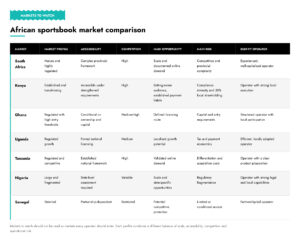
The table demonstrates why a simple ranking of the “best African betting markets” would be misleading.
South Africa offers scale, but not low-cost or uncomplicated entry. Kenya offers a betting-literate audience and mature payment habits, alongside the most demanding technical compliance regime on the continent. Nigeria offers population and state-specific opportunities, but requires an organisational structure capable of handling regulatory fragmentation. Senegal may restrict access, but restricted access provides competitive protection to operators able to enter through the appropriate institutional model.
Tanzania offers a useful illustration of competitive density. The Gaming Board of Tanzania lists more than thirty licensed online sports betting operators. This confirms both a functioning market and meaningful competition. An entrant needs a credible answer to why players would choose its product over the alternatives already available.
Uganda has a national regulator and a published list of licensed companies, providing a clearer starting point for assessing the competitive environment. The presence of a formal licensing framework does not settle the commercial question: taxation, payment costs, player value and localisation still need to be modelled together.
A highly regulated market may offer greater legal certainty but require more capital. A growth market may provide more space but carry higher execution risk. A restricted market may be difficult to access but commercially defensible once access is obtained.
The best market is not necessarily the largest or the least regulated. It is the one whose combination of demand, access and operating requirements fits the capabilities of the operator.
What Do African Market Reports Not Tell Sportsbook Operators?
Market reports are useful for identifying population, digital adoption, consumer interest and estimated sector growth. They are less effective at identifying the operational constraint most likely to delay or invalidate an investment.
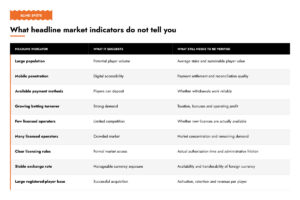
When the constraint is the regulator’s technical familiarity
There is a category of friction that appears on no market-entry checklist and which, in PlaylogiQ’s experience, absorbs more time than almost any other requirement: how familiar the local authority is with the technical concepts of the product.
The most frequent case concerns casino game payout. In some contexts, the concept of RTP is not fully understood by the administration, which may assume that return to player is a parameter the operator can adjust at will. Tax demands or operating prescriptions are sometimes formulated on that premise – and are technically impossible to execute. The payout of a certified game is set by the provider, verified by an independent laboratory, and cannot be altered downstream. Even if it could be, doing so would be incompatible with any serious responsible gambling policy.
The work that follows is not negotiation. It is explanation: documenting the certification chain, demonstrating that the parameter is structural rather than discretionary, and rebuilding an executable tax expectation on that basis. It requires direct engagement, translated technical material and time. An operator who does not plan for it discovers it after the licence has already been granted.
Administrative friction is a calendar item, not a footnote
In several jurisdictions, procedures remain partly paper-based, require physical presence, legalisations and sequential steps between offices, with timelines measured in months that rarely match those indicated informally. This is not an insurmountable obstacle, but it is a cost item and above all a scheduling dependency. In go-live planning, it should be treated as a critical path item, not a background formality.
A market that looked strong on paper
An anonymised market evaluation illustrates why these distinctions matter.
The initial indicators were excellent: a large population, high betting propensity, rapidly growing mobile penetration and competition that had not yet consolidated. On the basis of those numbers, the investment case wrote itself.
Closer analysis returned a different picture on three fronts simultaneously.
The payment ecosystem was less mature than mobile penetration suggested. The methods existed, but settlement times and reconciliation quality would have required substantially more integration work and operational supervision than anticipated. Real authorisation timelines proved longer than the informal indications gathered at the preliminary stage. And customer acquisition costs, tested against the channels actually available, were significantly above the initial estimates.
None of these three factors alone would have stopped the project. Together, they moved break-even beyond the approved capital horizon. The operator chose to slow down and rebuild the financial plan rather than force the go-live – a decision that proved correct in hindsight.
The most useful lesson from that file was not any of the three constraints individually.
From PlaylogiQ’s field. “The three constraints were not independent. They amplified one another.”
Investment principle: A market may look attractive on paper and still be incompatible with the capital, organisation, or time horizon of a particular operator. The useful question is not how large this market is, but which constraint will give way first – and whether the operator is equipped to absorb it.
Can Regulatory Risk Be Mitigated Through Execution?
No. This is the one category of risk that no market due diligence intercepts and no operational quality offsets.
In December 2025, the Ethiopian government suspended the country’s gaming licences through a system-wide decision unrelated to individual operators. Every active operator stopped at the same moment, regardless of performance, compliance record or licence seniority, pending a new regulatory framework.
Two operating conclusions follow.
Regulatory risk is mitigated through geographic diversification and nothing else. A portfolio concentrated on a single market is a portfolio with a single point of failure, however well it performs.
Continuity must be designed before the event. Technical architecture, contractual structure, and cost composition must allow a suspension in one jurisdiction not to degrade service in the others. That design decision is made at platform level, years before it is needed.
From PlaylogiQ’s field. “Regulatory risk cannot be mitigated through execution quality. It is mitigated through geographic diversification, and by nothing else.”
How to Choose the Right African Market for Your Sportsbook
Before selecting a market, an operator should be able to answer twelve essential questions.
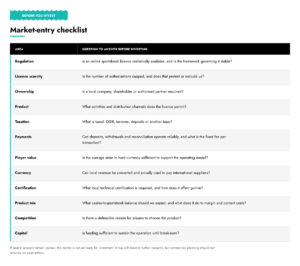
If several answers remain unclear, the market is not yet ready for investment. It may still deserve further research, but commercial planning should not advance on assumptions.
How Do You Decide Which African Market to Enter?
There is no universally best African sportsbook market. There are markets that fit a particular operator’s capital, technology, local capabilities and appetite for risk – and markets that do not.
Population, mobile adoption and betting participation remain valuable indicators, but they are evidence of potential demand rather than proof of an investment opportunity. Market size has not become irrelevant. It has simply lost its status as an independent criterion: it is the indicator with the worst ratio between visibility and predictive value when read on its own.
Smaller markets regularly prove more profitable than markets with far larger populations, and the reason is almost always the same. The outcome depends on the weakest constraint in the chain – regulatory, transactional, currency-related or operational – not on the most visible strength.
A credible assessment therefore combines:
-
-
- regulatory accessibility and licence stability;
- economic sustainability after tax;
- payment reliability and settlement times;
- transaction value and cost per transaction;
- foreign currency availability, not only the exchange rate;
- competitive structure;
- expected product mix;
- local operating capability.
-
Only once these have been evaluated does it make sense to estimate the required investment.
The next article in this series examines how much it costs to start a sportsbook in Africa, separating the visible cost of going live from the capital required to operate until the business reaches a sustainable scale.
PlaylogiQ works with structured operators entering and scaling in complex African markets, covering sportsbook infrastructure, payment localisation and compliance readiness. Book a demo to discuss a specific market.
FAQ
Is sports betting growing in Africa?
Sports betting continues to generate substantial activity across several African markets, but growth is not uniform. Mature markets, regulated growth jurisdictions and state-led ecosystems present very different opportunities and risks. Growth should therefore be assessed at country level, and in Nigeria and South Africa at state or provincial level, rather than continentally.
Is Africa still a good market for sportsbook operators?
It can be, but only where a specific jurisdiction fits the operator’s capital, technology and operating capabilities. Africa should not be treated as one homogeneous betting market. The same investment case can succeed in one jurisdiction and fail in a neighbouring one, because licensing, taxation, payment infrastructure and player value differ substantially between them.
Which African countries regulate online sports betting?
South Africa, Kenya, Ghana, Uganda and Tanzania all have formal regulatory frameworks for sports betting, although licensing models and online requirements differ significantly. Nigeria requires a state-level assessment following the Supreme Court’s confirmation of state competence over gaming, while Senegal operates a more state-led model centred on the national lottery.
What makes an African sportsbook market investable?
An investable market combines accessible and stable regulation, sustainable taxation, reliable payment settlement, sufficient player value in hard currency, manageable competition and an operating model that can be localised effectively. Crucially, investability is relative to a specific operator: a market that suits a well-capitalised group may not suit a first-time entrant.
What are the main risks of entering an African betting market?
The principal risks are regulatory change, licensing delays, tax structures applied to turnover or deposits rather than margin, payment settlement and reconciliation problems, currency depreciation or restricted access to foreign exchange, underestimated acquisition costs and insufficient local operating capability. These risks frequently compound one another rather than occurring in isolation.
Does a sportsbook operator need a local partner in Africa?
It depends on the jurisdiction and the entry model. Some markets require local ownership, a locally incorporated entity, an authorised partner or participation within a state-led framework. Kenya, for example, requires at least 30% Kenyan shareholding. The requirement must be verified before technology and commercial planning begin.
How important is mobile money for sportsbook operators in Africa?
In most African markets, mobile money is the primary payment channel rather than an alternative to cards. This changes the deposit flow, the withdrawal mechanism, where identity verification sits, and the entire reconciliation process. Operators should assess actual settlement times and reconciliation quality rather than simply counting available payment methods.
How does taxation affect sportsbook profitability in Africa?
Significantly, and the tax base matters more than the rate. Where tax applies to gross gaming revenue, the burden is proportional to margin. Where it applies to turnover or deposits, it becomes payable regardless of outcome – including in months when the bookmaker loses. Some markets are unviable for this reason alone.