



A limited online sportsbook launch using third-party infrastructure typically begins in the low-to-mid six figures. A localised operation with retail distribution or a proprietary multi-market platform can require seven figures or more. In some jurisdictions, minimum-capital requirements exceed the cost of the technology itself.
Those are planning orders of magnitude, not quotations. They are only meaningful alongside five declared variables: the market, the technology model, the licensing regime, the commercial strategy and the capital required to sustain at least the first full operating cycles. Quoting a figure before those are defined is the origin of the most common sizing error in the industry.
The more accurate answer is that the cost to start a sportsbook in Africa is not the price quoted for the platform. It is the capital required to secure market access, adapt the technology, connect local systems, acquire players, pay winners, and operate until the business can fund itself.
That distinction matters. A sportsbook can be technically ready to accept bets and still be financially unprepared to operate. Conversely, a more expensive technology proposal may reduce integration work, launch risk, and recurring operational costs.
This is the second part of our African sportsbook investment series. The first examines where operators may find genuine sports betting opportunities in Africa. This article focuses on the money required to enter and survive in one of those markets. The final part explains sportsbook revenue, profitability, and break-even.
The analysis combines published regulatory data with operating experience from PlaylogiQ across seven African jurisdictions.
Operator principle. A go-live budget tells you how much it costs to launch. An investment budget tells you whether the business can survive after launch.
In this article
-
-
- What does it actually cost to start a sportsbook?
- How does the entry model change the investment?
- The seven layers of sportsbook startup cost
- What do public licensing fees not include?
- Which sportsbook costs are most often underestimated?
- Are casino content costs a one-off or recurring?
- How much working capital does a sportsbook need?
- Why the same project needs two different budgets in two markets
- What are realistic sportsbook investment levels?
- How to build a realistic sportsbook budget
- FAQ
- What does it actually cost to start a sportsbook?
-
What Does It Actually Cost to Start a Sportsbook?
When prospective operators ask how much a sportsbook costs, the conversation usually begins with software. The platform is the most visible component and normally the first commercial proposal they receive. It is not the whole investment.
A credible financial plan separates three sets of figures that should never be added into a single number.
Implementation costs are finite and estimable: licence, platform setup, integrations, certifications, corporate formalities.
Recurring operating costs begin on the day of go-live and never stop.
Working capital is not a cost at all. It is a structural requirement of the operating model.
An operator can go live without a single technical problem and find itself in difficulty three months later, because it funded the first set correctly and not the other two.
A useful starting formula is:
Total capital required = pre-launch costs + recurring operating costs + player and payment liquidity + acquisition budget + contingency + cash runway
The distinction between cost and capital is equally important. A minimum-capital requirement is not necessarily a fee paid to the regulator. It may remain on the company balance sheet, but it still determines how much funding the project requires and how freely that money can be deployed.
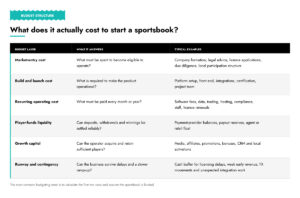
The most common budgeting error is to calculate the first two rows and assume the sportsbook is funded.
How Does the Entry Model Change the Investment?
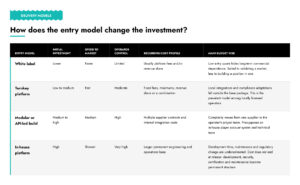
There is no single sportsbook software cost, because operators are not buying the same level of ownership or responsibility. White label or turnkey reduces pre-launch development. A modular model provides more freedom to select components. In-house technology transfers architecture, security, trading, compliance and maintenance to the operator.
The cheaper contract is not necessarily the cheaper operating model. Revenue share, third-party mark-ups and change requests become significant as volume grows. Equally, building proprietary technology before product-market fit locks capital into capabilities the first market does not need.
There is an observation that rarely appears in model comparisons, or in guidance on choosing a sportsbook platform provider, and it matters more than the pricing table.
From PlaylogiQ’s field. “The delivery model should be chosen according to the organisational structure you are genuinely able to sustain, not according to the budget available. An operator with no in-house technical team that opts for a modular architecture to save on licence fees ends up paying the difference in launch delays, incidents and dependence on external consultants.”
This choice should follow the investment thesis. An operator testing one market does not have the same requirements as a group planning to enter several jurisdictions with a shared technology core.
The Seven Layers of Sportsbook Startup Cost
This framework is more useful than a single headline price because it identifies where capital is committed and which assumptions need evidence.
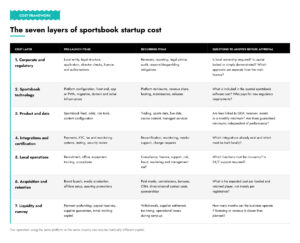
Two operators using the same platform in the same country can require materially different capital: one may have an existing local team, while the other needs a new entity, retail locations, several integrations and a larger acquisition programme.
What Do Public Licensing Fees Not Include?
Official fee schedules describe only part of the regulatory commitment – and they are the part most likely to be mistaken for the whole.
Tanzania: the fee schedule is public and specific
The Gaming Board of Tanzania publishes its full fee table. An internet sports betting licence carries a TZS 1 million application fee and a TZS 90 million licence fee. A sports betting principal licence carries a TZS 500,000 application fee and the same TZS 90 million licence fee, while each retail shop licence costs TZS 1 million. Adding online virtual games requires a further TZS 500,000 application fee, a TZS 3 million licence fee, and a 5% monthly GGR levy. Commercial gaming licences run for one year and are renewable.
Two things follow from reading the actual table rather than a single headline figure. Product scope multiplies the licensing bill, because each vertical is separately licensed. And retail distribution scales linearly: every shop is a licence line.
None of these figures includes company formation, technology, testing, payments, staff, marketing or liquidity.
Ghana: the largest number is not a fee at all
Ghana’s licensing framework sets a requirement of a different nature. The Gaming Commission of Ghana requires minimum stated capital of US$2,000,000 for sports betting, alongside US$2,500,000 for casinos and US$1,500,000 for route operations.
The critical detail is that this amount is not paid to the Commission. It is a condition precedent to the application – capital the company must demonstrate it holds. It does not leave the balance sheet, but it must exist before the process begins, and it is unavailable for anything else.
A second requirement stacks on top for foreign investors. Ghana Investment Promotion Centre rules set a separate minimum foreign capital threshold, reduced where a Ghanaian partner participates, and the Gaming Act requires Ghanaian ownership of at least 10% of the share capital of a sports betting company.
Two separate capital tests, one ownership condition, and none of them appears on a software invoice.
Kenya: compliance with a build cost attached
Kenya’s framework under the Gambling Control Act 2025 has moved from proposal to operation. Five subsidiary regulations were published in 2026, and the first licensing cycle under the new Act is open.
The technical obligations carry direct implementation costs: real-time regulatory access through a secure API, integration with a central monitoring system and national gambling register, geolocation technology, encrypted audit logs, segregation of player funds from operational accounts, and ongoing capital adequacy reporting. Applicants must be a body corporate with at least 30% of shares held by Kenyan citizens.
Each obligation creates cost without appearing under the word “licence”.
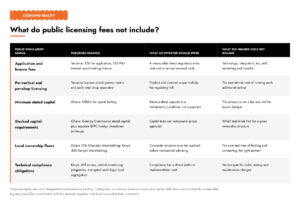
Editorial note. These examples are not a cheapest-to-most-expensive ranking. Categories, currencies, licence scopes and capital definitions are not directly comparable. Figures should be reconfirmed with the relevant regulator and local counsel before investment.
Which Sportsbook Costs Are Most Often Underestimated?
The answer is counter-intuitive, and it is not technology.
From PlaylogiQ’s field. “The platform has a stated price. It is discussed and negotiated – it is the one line everyone looks at. The line that is missing is the operating capital for the months after launch, the period in which revenue is still unstable and every function of the operation needs simultaneous attention. The most recurrent error is to concentrate the budget on the launch and leave residual resources for what follows. In practice, the post go-live period demands the greatest financial commitment, and it is the period in which a technically successful operation can stop for cash reasons.”
The lines most frequently absent or under-sized:
Payments and reconciliation. Adding a mobile-money logo is not the same as building a reliable payment operation. The budget must cover onboarding, API work, transaction fees, prefunding, failed payments, fraud controls, reconciliation and treasury. Reconciliation in particular is a labour cost whose volume follows the number of transactions, not their value.
Banking and currency conversion costs on multi-currency flows – a silent line that becomes a non-trivial percentage as volumes grow.
Bonuses, promotions and free bets, which are rarely modelled as a variable cost with a ceiling.
Fraud, chargebacks and risk supervision, which require people and not only rules.
KYC, compliance and regulatory adaptations after the licence has been granted.
Customer support in local languages and on the channels players actually use.
Maintenance and evolutionary development, recurring by definition.
Certifications and periodic audits: local technical certification per jurisdiction, penetration testing, regulator-mandated verifications.
Local staff, consultants and regulator relationship management.
Cost per contact on direct channels. SMS and messaging are paid per message and scale with the size of the player base, not its value. The same SMS infrastructure also carries verification and authentication traffic, which makes it a structural operating cost rather than a promotional line that can be suspended in a difficult month.
Taxes payable regardless of result, where the regime taxes deposits or turnover rather than margin.
Recurring administrative friction: procedures still partly paper-based, legalisations, physical presence, timelines measured in months.
Liquidity for withdrawals and winnings peaks.
Infrastructure scales with transactions, not revenue
There is a planning unit missing from almost every business plan, and in weak-currency markets it is the decisive one: cost per transaction.
An operation with a very low average stake has extremely high transactional density, and infrastructure does not scale with the value of bets but with their number. Computing capacity, bandwidth, storage, backup, monitoring, data retention and reconciliation load all grow with the count of movements, regardless of whether each is worth twenty cents or twenty euros.
This applies with particular force to payment fees. Where a fixed component exists per transaction, on low amounts that component becomes a significant percentage of the deposit, taken before the player has placed a bet. A budget built on average commission percentages, without modelling the distribution of amounts, systematically understates this line.
Operators planning for these markets should calculate three figures that rarely appear:
-
-
- Infrastructure cost per transaction
- Payment cost per average deposit
- Cost per contact on direct communication channels
-
They share the same property – they grow with count, not with value – and they are the numbers that indicate whether the operation holds at the projected scale.
Currency and supplier settlement
Revenue is earned locally while suppliers invoice in euros or US dollars. Budgeting must test both depreciation and availability: can local revenue cover the invoice, and can the operator actually obtain and transfer the currency when it falls due?
In some jurisdictions, access to foreign currency is rationed or subject to authorisation. An operator in good health can find itself unable to settle its international suppliers. Planning for this means three things: holding a hard-currency reserve, defining contractually which currency the relationship is denominated in and who carries the exchange risk, and negotiating in advance how remittance delays are handled – because the supplier will otherwise treat them as default.
Licensing delays
A licensing delay extends legal, project, payroll and supplier costs while revenue remains zero. The plan needs both a target date and a delayed-launch scenario. In several jurisdictions, procedures require physical presence, legalisations and sequential steps between offices, with real timelines that rarely match those indicated informally. In go-live planning, this belongs on the critical path, not in a footnote.
Are Casino Content Costs a One-Off or Recurring?
Recurring – and this is one of the most consistent misunderstandings among first-time operators.
Casino content is perceived as a technical integration, and therefore as a project cost incurred once. It is instead a recurring variable cost stream. Each provider has its own commercial model, typically a share of the margin generated, in some cases accompanied by guaranteed minimums payable regardless of actual performance. A wide casino content catalogue improves the offer and permanently increases the cost base.
There is a further decision that affects capital and which almost no operator at start-up stage confronts deliberately: whether to contract content providers directly, using the platform purely as an integration layer, or to delegate contractual management to the technology supplier.
Contracting directly reduces intermediation. It also requires negotiating competence, the capacity to sustain minimum commercial commitments and continuous administrative oversight. Delegating carries a higher unit cost and a management load close to zero.
From PlaylogiQ’s field. “In our experience, almost every operator at start-up stage chooses to delegate – not for economic reasons, but because the typical profile of a new entrant does not have the structure to manage the alternative. And it is the correct choice: the higher cost of an intermediated agreement is almost always lower than the cost of managing it badly on your own.”
How Much Working Capital Does a Sportsbook Need?
Working capital bridges the gap between opening the platform and sustainable cash generation. It is separate from the build budget, and it is a structural component of the model rather than an occasional reserve.
A sportsbook must be able to pay winnings at any moment – including on the day a high-exposure event goes the wrong way, and while incoming flows from payment providers arrive with their normal delay. The timing mismatch between collections and payouts is a permanent characteristic of the model, not an anomaly to manage when it appears.
At minimum, the model should cover:
-
-
- player withdrawals and winnings;
- payment-provider prefunding and settlement timing;
- supplier minimums and revenue-share payments;
- guarantees or deposits required by technology and content suppliers, which immobilise capital for the entire duration of the relationship;
- payroll, compliance and customer support;
- licence, tax and reporting obligations;
- marketing and bonus commitments;
- expected operating losses during ramp-up;
- delays, fraud events and foreign-exchange movements.
-
A useful calculation:
Required operating runway = monthly fixed costs × planned runway + variable-cost buffer + player-liquidity reserve + downside contingency
If the plan assumes break-even in month nine, funding only six months of operating cost does not make the project lean. It makes it incomplete.
There is also a commercial reason, not only a financial one.
From PlaylogiQ’s field. “Payout punctuality is one of the principal drivers of trust, and in markets where reputation travels through informal and very fast channels, a delay on withdrawals produces damage disproportionate to its amount. It is one of the few cases in which a treasury decision is also a marketing decision.”
The third article in this series develops the connection between sportsbook revenue, margin, cash flow and break-even.
Why the Same Project Needs Two Different Budgets in Two Markets
Two technically identical projects can require very different capital if they operate in different jurisdictions. The licence and its recurring costs, gaming taxation, local technical certification requirements, media costs, competitive pressure, the obligation or opportunity of a local presence and the depth of compliance obligations all shift the total.
More importantly, the dominant cost line changes from market to market.
In some countries the principal cost is player acquisition, in a context where effective digital channels are few and crowded. In others the real investment is building a reliable payment infrastructure, with multiple redundant providers and structured reconciliation oversight. In others again, the weight falls on local presence and management of the regulator relationship.
A budget transferred from one market to another without rebuilding this hierarchy is a wrong budget even when the total amount happens to be correct.
What Are Realistic Sportsbook Investment Levels?
Three operating models help establish the likely order of magnitude and the pressure points.
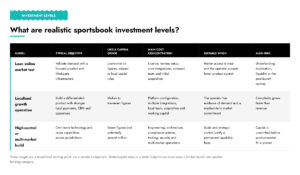
These ranges are a board-level starting point, not a vendor comparison. Stated-capital rules or a retail footprint can move even a limited launch into another funding category: Ghana’s US$2 million stated capital requirement alone exceeds the entire technology budget of a lean market test.
How to Build a Realistic Sportsbook Budget
A credible budget comes from market-specific evidence, not a generic percentage added to a platform quote.
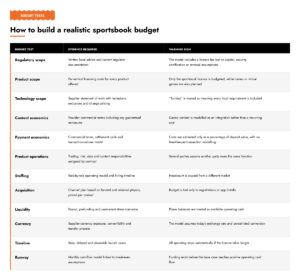
The output should be three figures rather than one:
-
-
- Cost to launch – the expenditure required to become operational.
- Capital to stabilise – the cash required to operate while the player base and revenue mature.
- Capital at risk – the total exposure under a defined downside scenario.
-
The third figure is the one an investor can compare with the potential return.
Operators should therefore resist asking only what the platform costs. The more useful question is: how much capital is required to launch, remain compliant, pay players, acquire a sustainable customer base and survive until break-even?
The next article answers the other side of that equation: how sportsbook revenue becomes profit, and how long recovering the investment may take.
PlaylogiQ works with structured operators entering and scaling in complex African markets, covering sportsbook infrastructure, payment localisation and delivery models from white label to modular. Book a demo to model a specific market.
FAQ
How much does it cost to start a sportsbook in Africa?
A limited online launch using third-party infrastructure may begin in the low-to-mid six figures, while a localised, retail, proprietary or multi-market operation can require seven figures or more. Local licensing and minimum-capital rules can materially change the total. These are planning orders of magnitude, not quotations, and only meaningful alongside a defined market and technology model.
Is sportsbook software the largest startup cost?
Not usually. In most markets, regulatory capital, player liquidity, marketing, payment integrations or the operating runway exceed the initial sportsbook software cost. The platform is simply the most visible line because it arrives as a commercial proposal. The line most often under-funded is operating capital for the months following launch.
What is included in sportsbook software cost?
It may include the betting engine, front end, back office, managed trading, hosting and standard integrations. Local payments, KYC, certification, regulatory reporting, custom development, casino content and support are frequently priced separately. Operators should request a detailed statement of work specifying inclusions, exclusions and change-request pricing before comparing quotes.
Is a white-label sportsbook cheaper than building in-house?
It normally requires less initial capital and reaches the market faster. It may, however, involve revenue share, supplier minimums, restrictions and additional localisation fees. In-house development costs more initially and creates a larger permanent operating responsibility covering development, security, certification and maintenance indefinitely.
How much working capital does a sportsbook need?
Enough to cover player payouts, payment prefunding, supplier minimums and guarantees, payroll, compliance, marketing and operating losses until the business reaches sustainable cash generation, plus a downside contingency. The amount should come from a monthly cash-flow model rather than a percentage of the launch budget, because payout timing is structurally mismatched with collections.
Are African sportsbook licence fees comparable between countries?
Not directly. Some published figures are application or annual fees, others are minimum stated capital, security deposits, per-shop charges or platform authorisations. Ghana’s US$2 million stated capital, for example, is not paid to the regulator at all. Licence scope, validity and tax treatment also differ substantially between jurisdictions.
How much does a sportsbook licence cost in Tanzania?
The Gaming Board of Tanzania publishes a TZS 1 million application fee and a TZS 90 million licence fee for internet sports betting, renewable annually. Retail shop licences and additional verticals such as virtual games are licensed and charged separately, so product and channel scope directly multiply the regulatory bill.
Do casino content costs stop after integration?
No. Casino content is a recurring variable cost, typically structured as a share of margin generated and sometimes accompanied by guaranteed minimums payable regardless of performance. A wider catalogue improves the player offer and permanently increases the cost base. It should be modelled as an ongoing line, not a project cost.