




A sportsbook can process millions in bets and still lose money. Betting turnover is not revenue. Gross Gaming Revenue is not profit. Net Gaming Revenue is a contractual base, not the operator’s margin. And reaching monthly break-even does not mean the initial investment has been recovered.
The chain runs turnover → GGR → NGR → operating profit, and it breaks lower down than most operators expect. The costly confusion is not the definition of each indicator – those are well known. It is that one of them, NGR, is routinely credited with a meaning it does not have.
This matters particularly in African markets, where low average stakes coexist with high transaction volumes, payment costs are sensitive to transaction count, and international suppliers are paid in a currency other than the one players bet in. A market can generate visible activity without producing enough cash contribution to support the operator behind it.
There is therefore no credible universal answer to “how much does a sportsbook make?” Profitability depends on hold, product mix, bonuses, taxation, payment economics, acquisition efficiency, and the cost of operating locally.
This is the third part of our African sportsbook investment series. The first identifies sports betting opportunities in African markets. The second calculates the capital required to start and sustain a sportsbook. This article connects the two: how betting activity becomes revenue, when revenue becomes profit, and when profit finally repays the investment.
The analysis combines published regulatory data with operating experience from PlaylogiQ across seven African jurisdictions.
Investment principle. A large betting market is not automatically a profitable market, and a profitable month is not the same as investment payback.
In this article
-
-
- How does a sportsbook make money?
- What is the difference between turnover, GGR, NGR and profit?
- Is NGR the operator’s margin?
- Why turnover predicts more than it is given credit for
- What does public African betting data actually show?
- What determines sportsbook profit margin?
- Can two operators with the same turnover have different profits?
- Can taxation make a market unviable?
- Why sportsbook profitability differs across African markets
- How to calculate sportsbook break-even
- How long does it take to recover the investment?
- What actually accelerates break-even?
- Which metrics should sportsbook investors monitor?
- How should operators assess sportsbook revenue potential?
- FAQ
- How does a sportsbook make money?
-
How Does a Sportsbook Make Money?
A fixed-odds sportsbook accepts stakes and pays winning bets according to the odds offered. Its first economic layer is the difference between betting activity and player winnings.
GGR = accepted stakes − winnings paid
If players stake €10 million and receive €9.2 million in winnings, the sportsbook records €800,000 in GGR. The corresponding gross hold is 8%:
Gross hold percentage = GGR ÷ turnover × 100
That €800,000 is not the operator’s profit. Gaming taxes, bonuses, platform and data fees, payments, trading, fraud, staff, marketing and general operating costs still have to be deducted, and they sit at different points in the chain depending on jurisdiction and contract.
The sportsbook also does not earn the same margin every week. Results move around major events, favourite outcomes, accumulator composition, bet mix and the operator’s risk position. A sustainable model uses normalised performance over an appropriate period rather than one favourable month.
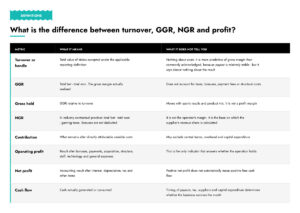
What Is the Difference Between Turnover, GGR, NGR and Profit?
The word “revenue” is applied to several different figures. Any serious sportsbook profitability analysis must define each one explicitly – and must resist comparing them between operators as though they were homogeneous.
Is NGR the Operator’s Margin?
No. This is the most expensive misreading in the sector, and it is worth stating plainly.
In industry contractual practice, NGR is defined as total bet minus total won minus gaming taxes. Bonuses do not enter the calculation. This is not an oversight. NGR originated as the basis for computing the commission owed to the platform and content supplier, and bonuses are a commercial lever the operator decides on independently.
The consequence is asymmetric, and it needs to be understood before signature rather than after.
From PlaylogiQ’s field. “Promotional cost falls entirely on the operator and usually does not reduce the base on which revenue share accrues. An aggressive bonus campaign can increase turnover, increase GGR, increase NGR – and simultaneously reduce operating profit. An operator reading its own performance on NGR is watching an indicator moving in the wrong direction relative to its profit and loss.”
The negotiation this creates
GGR has a substantially unambiguous definition. NGR does not: it depends on which taxes and which costs the contract admits as deductions, and different formulations produce calculation bases with significant divergence.
The definition of deductions therefore deserves the same attention normally given to the percentage. A more favourable percentage on a wider base can be worth less than a higher percentage on a correctly scoped one.
One check in particular is worth making explicitly: verify that costs charged as direct do not produce a double effect on the operator’s result, penalising it first in the loss and then again in the base on which commissions are calculated.
Rule for every financial model. Turnover is a volume indicator. NGR is a contractual indicator. Neither is a profitability indicator. An operator can improve both and worsen its profit and loss in the same quarter, and bonuses are the mechanism through which this happens.
Why Turnover Predicts More Than It Is Given Credit For
The standard position is that turnover is the most visible indicator and the least informative. The reality is more nuanced: turnover says something reliable about gross margin, and almost nothing about the result. The chain does not break between turnover and GGR. It breaks lower down.
On the casino side, conversion from turnover to gross margin is relatively predictable, for a technical reason: certified providers operate with a declared and verified payout that cannot be adjusted at will. Theoretical margin on volume is therefore fairly uniform across comparable catalogues, and at significant volumes the realised figure converges on the theoretical. Knowing an operation’s casino turnover allows its GGR to be estimated within a narrow error margin.
On the sportsbook side, predictability depends on bet composition – and here African markets present a recurring structural characteristic.
The prevailing share of volume consists of accumulator bets placed pre-match. Theoretical margin compounds across multiple selections and the probability of an outcome favourable to the player falls, which makes the bookmaker’s margin higher and the risk more contained. From the book’s point of view, the prematch accumulator is the most comfortable combination that exists.
This is the opposite of mature European markets, where live betting has become dominant and is expressed almost always in singles: thinner unit margin, more concentrated exposure, a requirement for real-time risk management. Sportsbook GGR in the markets PlaylogiQ operates in therefore tends to be solid and relatively stable.
The trend is moving, though.
From PlaylogiQ’s field. “We see live betting growing, and we see a segment of more expert players emerging alongside the occasional small-stake audience. They behave differently: they select, they look for value, they play singles. It compresses margin and simultaneously raises the technology requirement, because live demands low latency, continuously updated odds and active risk supervision.”
A financial plan built on the historic hold of a prematch accumulator portfolio is implicitly assuming that composition will not change. That is not a prudent assumption.
What Does Public African Betting Data Actually Show?
Public regulator data can show the scale of a market. It cannot reveal the profitability of an individual sportsbook.
South Africa provides the clearest public example on the continent.
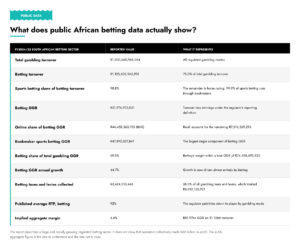
The report describes a large and rapidly growing regulated betting sector. It does not show that operators collectively made R52 billion in profit. That GGR still had to absorb taxes, promotions, payments, platform costs, staff, marketing, compliance and premises.
What the effective tax rate actually is
The regulator’s figures allow a calculation that is rarely made. Taxes and levies on bookmaker sports betting were R3,029,076,280 against bookmaker sports betting GGR of R47,892,027,847 – an effective rate of approximately 6.3% of GGR.
This matters for a live reason. National Treasury has proposed a 20% national tax on GGR from online betting, in addition to existing provincial GGR taxes which currently range from 6% to 9%. Measured against the effective rate actually being paid, that proposal would more than quadruple the tax burden on online betting margin. An operator modelling South African unit economics on today’s provincial rates alone is modelling a regime that may not persist.
The same country, radically different hold
The most instructive figure in the NGB report is one that almost nobody cites. The regulator publishes average return to player for betting by province, and the spread is extreme: Mpumalanga reported 96-97% across the four quarters, Western Cape 94-95%, while Gauteng reported 83-87% and Free State 86-87%.
Translated into operator terms, that is a gross hold ranging from roughly 3% to roughly 17% within a single national market, under a single national framework, on the same product.
The spread reflects differences in operator mix, bet composition and product profile between provinces rather than differences in pricing skill alone. But it makes the point of this article empirically, and from the regulator rather than from us: two operations with the same turnover can produce gross margins that are not comparable. Any model built on a national average hold is built on a number that describes almost no individual operator.
The 4.6% aggregate figure is the one to understand and the one not to copy. Dividing reported betting GGR by reported betting turnover is useful for illustrating the distance between betting activity and retained gaming revenue. It is not a target hold. The sector totals combine bookmakers, totalisators, sports betting and horse racing, and the regulator applies a specific fixed-odds turnover definition that includes recycled stakes.
What Determines Sportsbook Profit Margin?
Sportsbook profitability is shaped by several connected margins rather than one number.
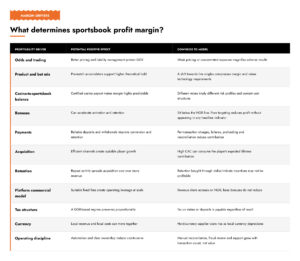
Margin optimisation is not simply a matter of offering less competitive odds. An operator can improve reported hold while damaging conversion, trust and long-term player value. The objective is sustainable contribution across the customer lifecycle, not the highest possible margin on a short sample.
Can Two Operators With the Same Turnover Have Different Profits?
Yes – and the divergence can be several-fold.
The most instructive case is two operations with comparable volumes and divergent economic results. The first grew rapidly, with aggressive acquisition, generous bonuses and a very wide catalogue. The second grew more slowly, with selective promotions, a tighter offer and strong oversight of payment processes.
On volume, the first appeared clearly ahead. It was also ahead on NGR. On operating profit the second produced a result several times higher.
The following schema reproduces the mechanics. Values are indexed to a turnover of 100 and are purely illustrative.
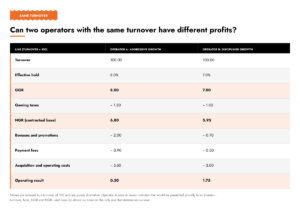
The decisive element is that Operator A wins on every indicator that would be presented proudly to an investor – turnover, hold, GGR and NGR – and loses by almost six times on the only one that determines survival.
Bonuses, the principal cause of the divergence, sit below the NGR line. They appear in none of the four indicators above it.
There is a second-order effect worth noting. Because supplier revenue share accrues on NGR, Operator A also pays commission on a base of 6.80 against Operator B’s 5.95. It generates a higher contractual base, pays more for it, and takes home a fraction of the profit.
None of Operator A’s cost lines, taken individually, is out of market. It is their composition along the chain that consumes the result.
The currency layer on top
In weak-currency markets, a further factor overlays this schema. The result is measured in local currency, while a significant part of the cost base – platform, content, infrastructure, sports data – is denominated in hard currency. A rising NGR in local currency can therefore coexist with a contracting margin in the currency that actually has to be paid.
When assessing a historic series across several quarters, the dual reading – local currency and settlement currency – is not an accounting refinement. It is a condition for understanding what is happening.
This table also exposes the limitation of any bookmaker margin calculator that stops at hold percentage. Hold estimates GGR. It does not calculate sportsbook profit.
Can Taxation Make a Market Unviable?
If the step from turnover to GGR is relatively stable, the step from GGR to NGR is not, because it depends on the jurisdiction’s tax regime – and regimes are not variations on a theme. They are different models.
Where tax applies to gross margin, the logic is proportional: you pay according to what you earned.
There are jurisdictions, however, that tax deposits or turnover collected instead of margin. The change is one of nature, not of degree. Tax becomes payable regardless of the outcome of play. It is paid in a month when the bookmaker lost. And in a high-density microtransaction context it compounds with the fixed component of payment fees, striking the same amount before any margin exists at all.
The conclusion is uncomfortable but has to be stated: there are markets in which, all else equal, the economic model does not close for the operator. Not because the market is small or competition excessive, but because the fiscal structure absorbs margin before the operation can produce it.
This is a check to be run with the real numbers of your own product mix, before committing capital to a licence.
Why Sportsbook Profitability Differs Across African Markets
Average stake and transaction density
Population and player activity do not determine economic value on their own. Markets with smaller average stakes generate many more deposits, withdrawals, bet settlements and support interactions for the same GGR.
Where payment or operational costs are linked to transaction count, cost-to-serve remains high even as turnover grows. Models should include transactions per active player and cost per transaction alongside turnover per player.
Payment reliability and liquidity
Fast, predictable withdrawals support trust and retention, but they require liquidity, prefunding and reconciliation. Failed transactions generate support demand and distort the relationship between registered accounts, funded accounts and genuinely active players.
Payment success rate, withdrawal time and reconciliation exceptions belong in the profitability model, not only in the technical dashboard.
Currency and convertibility
An operator can be profitable in local currency while unable to pay its international platform, data or specialist suppliers. Depreciation increases the local cost of foreign invoices; convertibility restrictions can make settlement impossible even when sufficient local cash exists.
Profitability should be assessed in both operating currency and investor currency, with a downside FX scenario.
Regulation and tax base
The rate is only part of the calculation. Operators must establish whether taxes and levies apply to stakes, deposits, GGR, a defined form of NGR, winnings or a combination. Reporting, monitoring and licence costs belong in the same model.
Two markets with similar headline demand can produce materially different contribution once their regulatory economics are applied.
Acquisition and local execution
The cheapest registration is not the most valuable customer. Investors should compare acquisition spend with funded-player conversion, retention and contribution after bonuses and payment costs.
On direct channels, the economics change shape entirely: cost is per contact rather than per impression, so it scales with the number of recipients and not with their value. On a low average-revenue-per-player base, an unsegmented retention campaign can cost more than the margin it generates.
How to Calculate Sportsbook Break-Even
“Break-even” describes three different milestones. Using the term without specifying which one creates false expectations.
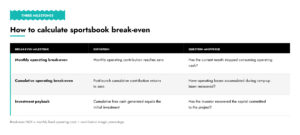
The basic monthly calculation:
Break-even NGR = monthly fixed operating costs ÷ contribution margin percentage
If fixed costs are €100,000 per month and 40% of NGR remains after variable costs, the sportsbook needs €250,000 in monthly NGR to reach operating break-even:
€100,000 ÷ 40% = €250,000
This still does not recover licensing, platform implementation, pre-launch payroll, launch marketing, or previous operating losses. Those belong in the investment-payback calculation.
How Long Does It Take to Recover the Investment?
There is no standard sportsbook payback period, and any provider that promises one should be treated with caution. Duration depends on market maturity, available capital, competitive pressure, the licensing regime and the ability to acquire and retain players at a sustainable cost.
In favourable conditions – a market with unconsolidated competition, reliable payments, a light structure – an operator can approach equilibrium relatively quickly. In competitive markets, or where initial investment in licence and infrastructure is substantial, the period can be considerably longer.
Consider an illustrative operator with an initial investment of €600,000.
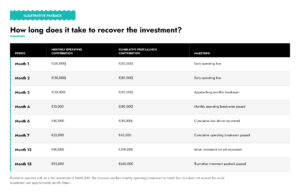
This scenario assumes months 5, 8 to 11 and 13 to 14 follow a smooth growth path between the displayed values. It excludes financing costs, corporate profit tax, additional capital expenditure, and profit distributions.
The important point is that the business reaches monthly operating break-even in month four but does not recover the initial investment until approximately month fifteen. Calling the project “break-even” at month four would be technically possible and commercially misleading.
The expectations that recur
The most frequent expectation is that launch will rapidly generate volumes sufficient to offset the initial investment. In reality, the first months are characterised by high costs, market learning, channel optimisation and trust-building – and trust, in these markets, is built through repeated operational behaviour, not through campaigns.
The second problematic expectation is that growth will be linear. It is not. It tends to become progressively more efficient as retention, segmentation, bonus control and understanding of local behaviour improve.
A credible business plan therefore includes prudential scenarios, an explicit learning period and capital sufficient to absorb variance – not a single path built on the best case.
From PlaylogiQ’s field. “The prudent approach is not choosing the right hypothesis. It is working with multiple scenarios and checking the gap between forecast and actual data at regular intervals – because in most cases the problem is not that break-even arrives late. It is that it is recognised late.”
For a reliable payback model, start from the full capital requirement described in how much it costs to start a sportsbook in Africa, then test at least three cases: a base case, a delayed-launch or slower-acquisition case, and a downside combining weaker hold, higher CAC, and adverse currency movement.
What Actually Accelerates Break-Even?
The variables that in PlaylogiQ’s experience move the equilibrium point most:
-
-
- acquisition cost and channel quality – two channels with the same cost per registration produce very different values over time;
- segmentation discipline on direct channels, where contact cost is nearly fixed and an unsegmented campaign can consume more margin than it generates;
- retention and playing frequency, which depend on technical reliability and withdrawal punctuality more than on promotions;
- product mix between casino and sportsbook and, within the sportsbook, the share of prematch accumulators against live singles;
- effective hold and the volatility of sports results;
- incidence of bonuses, promotions and free bets – the fastest lever to correct, the one most often left running, and the one that does not appear in NGR;
- cost per transaction, where average stake is low and transactional density high;
- payment fees, fraud and chargebacks;
- taxation and regulatory costs;
- efficiency of operating processes and support;
- technical stability of the platform and quality of localisation;
- size and flexibility of the organisation during the months when revenue is still unstable.
-
Break-even depends on the ability to convert volume into margin, and margin into a result sufficient to cover the entire cost structure. That conversion happens at points in the chain which volume, on its own, does not illuminate.
Which Metrics Should Sportsbook Investors Monitor?
An investment dashboard should connect player activity to cash generation.
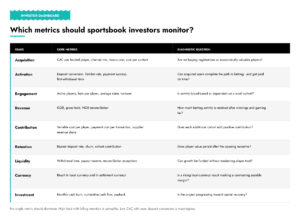
No single metric should dominate. High hold with falling retention is unhealthy. Low CAC with poor deposit conversion is meaningless. Rapid GGR growth with negative cash flow may simply indicate that working-capital and acquisition requirements are growing faster than contribution.
Key principle. High turnover does not necessarily indicate a profitable operation. The result depends on hold, product mix, taxation, bonuses, payment costs, player acquisition and operating expenditure. Sustainability does not come from the ability to generate volume, nor even from the ability to generate NGR. It comes from the ability to retain what remains below that line.
How Should Operators Assess Sportsbook Revenue Potential?
Sportsbook revenue in Africa can be substantial, as South Africa’s public data demonstrates. But market-level GGR does not answer how much an individual operator will make.
Profit emerges only after the operator converts reachable demand into funded and retained players, manages betting risk, controls bonuses and payment costs, absorbs taxes and supplier commissions, and operates efficiently in both local and hard currency. Break-even then arrives in stages: first monthly operations, then accumulated launch losses, and finally the original investment.
The investment decision should follow a complete sequence:
-
-
- Identify an accessible and economically suitable market – see sports betting opportunities in Africa.
- Calculate the complete funding requirement – see the cost of starting a sportsbook in Africa.
- Model GGR, contribution, cash flow and investment payback under several scenarios.
-
The right question is not how much revenue this market can generate. It is:
How much sustainable cash can this operator generate from this market, after every cost required to acquire, serve and retain its players?
PlaylogiQ works with structured operators entering and scaling in complex African markets, covering sportsbook infrastructure, payment localisation and commercial models built around the operator’s actual cost chain. Book a demo to model a specific market.
FAQ
How does a sportsbook make money?
A sportsbook retains the difference between accepted stakes and winnings paid, recorded as Gross Gaming Revenue. Profit is what remains after gaming taxes, bonuses, platform and data fees, payment costs, staff, marketing, compliance and other operating expenses. GGR is the starting point of the calculation, not the answer to it.
Is NGR the same as an operator’s profit?
No. In industry contractual practice, NGR is total bet minus total won minus gaming taxes, with bonuses excluded from the calculation. It exists as the base for computing the supplier’s revenue share, not as a measure of operator margin. An operator can increase NGR and reduce operating profit in the same quarter.
What is a sportsbook profit margin?
The term can refer to gross hold, contribution margin, EBITDA margin or net profit margin, which are different measures entirely. Any percentage should state both its numerator and denominator before being compared with another operator. Gross hold in particular estimates GGR and says nothing about profitability.
What is the difference between turnover and sportsbook revenue?
Turnover measures betting activity under the applicable reporting definition. GGR is what is retained after player winnings. NGR then deducts gaming taxes, and operating profit deducts everything else. High turnover does not produce a profitable sportsbook, though it is more predictive of gross margin than commonly assumed.
What is a typical bookmaker margin?
There is no universal margin. Gross hold varies with sport, odds, bet type, player mix and results. In African markets, prematch accumulators are prevalent and support a higher theoretical hold than the live singles that dominate mature European markets. A market-wide aggregate ratio should never be copied into an operator forecast.
How long does a sportsbook take to break even?
It depends on initial investment, launch timing, revenue ramp and cost structure, and no credible standard period exists. Operators should distinguish three milestones: monthly operating break-even, recovery of accumulated operating losses, and full investment payback. The three can be many months apart from one another.
How should sportsbook ROI be calculated?
A simplified calculation is cumulative net cash returned divided by total capital invested. The model should specify the measurement period and include additional funding, corporate tax, capital expenditure and working-capital movements, not only accounting profit. It should also be read in both operating currency and settlement currency.
Can taxation make an African betting market unprofitable?
Yes. Where tax applies to deposits or turnover rather than gross margin, it becomes payable regardless of the outcome of play, including in months when the bookmaker loses. In high-density microtransaction markets it compounds with fixed payment fees, striking the same amount before any margin exists.